
Strategic Asset Management Summary
Insulating oil is the lifeblood of liquid-immersed transformers. Beyond cooling and electrical insulation, its molecular condition reflects the internal health of the transformer core and windings. Timely execution of Transformer Oil Sampling and Diagnostics provides a 3-to-5-year lead time before catastrophic insulation breakdown occurs, safeguarding critical utility infrastructure and reducing lifecycle expenditure by up to 40%.
01. The Engineering Physics of Transformer Dielectric Degradation
In high-voltage electrical transformers, mineral oil and natural ester fluids undergo continuous chemical, thermal, and electrical stresses. Over operating life cycles spanning several decades, these insulation fluids degrade through three primary mechanisms: oxidation, thermal decomposition, and electrical ionization.
When dielectric mineral oil is exposed to localized thermal hotspots (resulting from core saturation, stray flux, or poor contact resistance in tap changers) or electrical stresses (such as partial discharges, tracking, or high-energy arcing), hydrocarbon chains crack. This bond cleavage produces characteristic light hydrocarbon gases and carbon oxides, which dissolve directly into the surrounding fluid.
02. Dissolved Gas Analysis (DGA) & Key Fault Gas Interpretation
Dissolved Gas Analysis (DGA) is universally recognized as the single most effective diagnostic tool for monitoring power transformer health. By quantifying gas concentrations in parts per million ($\text{ppm}$) and evaluating generation rates, diagnostic engineers can precisely classify internal incipient faults.
According to international standards IEC 60599 and IEEE C57.104, diagnostic interpretation revolves around key fault-indicative gases:
| Fault Gas | Chemical Formula | Primary Fault Mechanism | Thermal/Electrical Threshold |
|---|---|---|---|
| Hydrogen | $\text{H}_2$ | Partial Discharge (Corona), Electrolysis | Low energy electrical stress ($>150^\circ\text{C}$) |
| Methane | $\text{CH}_4$ | Low-Temperature Thermal Overheating | $150^\circ\text{C} - 300^\circ\text{C}$ Thermal stress |
| Ethane | $\text{C}_2\text{H}_6$ | Medium-Temperature Thermal Overheating | $300^\circ\text{C} - 700^\circ\text{C}$ Thermal stress |
| Ethylene | $\text{C}_2\text{H}_4$ | High-Temperature Thermal Overheating | $>700^\circ\text{C}$ Intense thermal hotspots |
| Acetylene | $\text{C}_2\text{H}_2$ | High-Energy Arcing & Sparking | Critical electrical breakdown ($>1000^\circ\text{C}$) |
| Carbon Monoxide | $\text{CO}$ | Cellulose Paper Degradation | Thermal degradation of solid insulation |
| Carbon Dioxide | $\text{CO}_2$ | Paper Aging / Oxidation | Normal aging or low thermal cellulose stress |
Advanced Diagnostic Diagnostic Methods: Duval Triangles and Rogers Ratios
Standard gas concentrations alone do not reveal complex fault dynamics. Expert diagnostic evaluation utilizes graphical representation methods such as Duval Triangle 1, 4, and 5, alongside Rogers Gas Ratios and IEC 60599 ratio codes ($\text{C}_2\text{H}_2/\text{C}_2\text{H}_4$, $\text{CH}_4/\text{H}_2$, $\text{C}_2\text{H}_4/\text{C}_2\text{H}_6$).
For instance, a high concentration of Ethylene ($\text{C}_2\text{H}_4$) accompanied by traces of Acetylene ($\text{C}_2\text{H}_2$) points toward severe thermal decomposition of the oil surrounding tap-changer contacts or localized core laminations, necessitating immediate load reduction and site verification.
03. Physical, Chemical, and Dielectric Fluid Parameter Matrix
In addition to dissolved gas screening, complete fluid health evaluation requires rigorous physical and chemical laboratory testing as prescribed by IEC 60422.
Dielectric Breakdown Voltage (BDV)
Measures the fluid's ability to withstand electrical stress (IEC 60156). A sharp drop in breakdown voltage ($<30\text{ kV}$) signals free water accumulation or particulate contamination.
Moisture Content (Karl Fischer Titration)
Expressed in parts per million ($\text{ppm}$ according to IEC 60814). Water migrates dynamically between paper and oil based on temperature. High moisture accelerates solid insulation aging exponentially.
Acid Neutralization Number
Determines organic acid concentration resulting from oxidation ($\text{mg KOH/g}$). Acids cause internal metal corrosion and promote sludge formation, clogging cooling radiator passages.
Interfacial Tension (IFT)
Evaluates polar contaminants and degradation products ($\text{mN/m}$). A reduction in IFT combined with rising acidity confirms advanced oil decay and impending sludge precipitation.
Dielectric Dissipation Factor (Tan Delta)
Quantifies power loss in the insulating fluid at elevated operating temperatures ($90^\circ\text{C}$). High tan delta reflects conductive soluble contaminants and micro-particulates.
Furan Analysis (2-Furaldehyde)
Measures degradation compounds of the solid cellulosic paper (ASTM D5837). Furan concentration directly correlates to the remaining Degree of Polymerization (DP) of paper insulation.
04. Standard Protocol for Oil Sampling Field Execution
Diagnostic accuracy relies heavily on sampling precision. Incorrect sampling techniques introduce ambient air, moisture, or dust, generating false-positive DGA readings. EUROGULF field teams adhere strictly to IEC 60567 / ASTM D923 protocols:
- Flush Equipment Valves: Drain a minimum of 2 to 5 liters of oil through the bottom sampling port to purge stagnant fluid, sediment, and moisture trapped in valve dead-legs.
- Gas-Tight Glass Syringes for DGA: Use calibrated, stainless-steel or gas-tight glass syringes fitted with three-way stopcocks. This preserves dissolved light hydrocarbon gases ($\text{H}_2, \text{CH}_4$) without atmospheric venting.
- Amber Glass Bottles for Physical Tests: Collect physical and chemical samples in clean, dry, UV-blocking amber glass bottles, leaving minimal headspace to avoid fluid oxidation during transport.
- Environmental Parameter Logging: Document top-oil temperature, ambient temperature, relative humidity, wind conditions, and unit load status at the exact moment of sampling.
05. EUROGULF Transformer & Diagnostic Services Portfolio
Leveraging our 100,000 sq ft state-of-the-art facility in Sharjah, UAE, and over 30 years of manufacturing and service excellence, EUROGULF offers full-lifecycle solutions:
Power Transformers (up to 132kV)
Custom-engineered power, step-up, and distribution units type-tested by KEMA (Netherlands) and CESI (Italy), built for extreme ambient temperatures up to $55^\circ\text{C}$.
Package & Unit Substations
Compact, integrated medium-voltage substation modules engineered for utility networks, industrial plants, oil & gas, and renewable infrastructure.
On-Site Testing & Commissioning
Comprehensive field testing including winding resistance, turns ratio (TTR), sweep frequency response analysis (SFRA), insulation resistance, and oil sampling.
Oil Regeneration & Reclaiming
Mobile oil vacuum dehydration, degassing, and Fuller's Earth reclamation services to restore dielectric properties and extend asset operational life.
06. Future Trends in Procurement & Transformer Diagnostics (2025–2035)
As power grids integrate higher percentages of renewable energy, load profiles become variable and unpredictable. Utility procurement officers and asset managers must adapt to modern diagnostic innovations:
1. Transition to Synthetic & Natural Esters (Bio-Fluids)
Biodegradable ester liquids offer higher fire flashpoints ($>300^\circ\text{C}$) and superior environmental safety compared to mineral oil. However, esters exhibit different water solubility kinetics and gas evolution patterns. Future diagnostics mandate ester-specific DGA ratio standards and moisture saturation percentage calibration.
2. Multi-Gas Online DGA Sensors (IoT / SCADA Integration)
Periodic offline sampling is increasingly supplemented by continuous online DGA monitors. Modern photoacoustic spectroscopy (PAS) sensors track 9 key gases in real time, transmitting data directly to utility SCADA systems via Modbus, DNP3, or IEC 61850 protocols.
3. AI-Driven Predictive Health Indexing
Machine learning models fuse DGA telemetry, thermography, load history, and partial discharge acoustic data to compute a dynamic Asset Health Index (AHI). Procurement teams leverage AHI to prioritize capital expenditure (CapEx) for transformer replacement or refurbishing years before unexpected outages occur.
07. Enterprise Strengths & E-E-A-T Authority of EUROGULF
Established in 1995 in the Hamriyah Free Zone, Sharjah, UAE, EUROGULF Transformers has established itself as an industry authority in power equipment manufacturing and asset health diagnostic services.
- Purpose-Built Manufacturing Facility: Spanning 100,000 square feet, our plant houses precision winding machines, automated vacuum drying chambers, and oil processing systems.
- KEMA & CESI Type-Tested Validation: Transformer designs undergo short-circuit withstand and impulse voltage type-testing at globally renowned independent laboratories (KEMA Netherlands, CESI Italy).
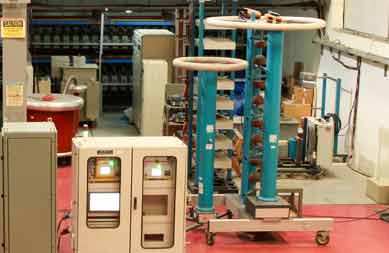
- Calibrated High Voltage Testing Laboratory: Outfitted with modern instruments calibrated to IEC 60076, IEEE C57.12.00, BS, NEMA, and IS standards for routine, type, and special diagnostic testing.
- Integrated Quality Management: Fully accredited under ISO 9001 (Quality Management), ISO 14001 (Environmental Management), and ISO 45001 (Occupational Health & Safety).

08. Frequently Asked Procurement & Technical Questions (FAQ)
According to IEC 60422 and IEEE C57.104, critical power transformers ($>10\text{ MVA}$ or $\ge 69\text{ kV}$) should undergo routine physical/chemical oil testing and Dissolved Gas Analysis (DGA) at least once per year. For mission-critical utility units, bi-annual DGA screening is standard. If abnormal gas generation rates ($\Delta \text{ppm/day}$) are detected, sampling intervals should be reduced to monthly or weekly monitoring until fault stabilization.
Acetylene ($\text{C}_2\text{H}_2$) is formed exclusively at extremely high temperatures ($>1000^\circ\text{C}$), indicating high-energy electrical arcing, severe contact flashover, or winding breakdown. Even trace levels ($>2\text{ to }5\text{ ppm}$) demand immediate investigation, gas generation rate tracking, and potential unit de-energization for internal inspection.
Water decreases the dielectric breakdown strength of fluid, accelerates thermal degradation of paper insulation, and increases risk of bubble formation at high loads. Excess moisture combined with elevated temperatures speeds up cellulose hydrolysis, permanently reducing the mechanical strength of the paper insulation.
Yes, routine oil sampling from bottom sampling valves is routinely conducted on energized transformers. However, strict safety precautions must be followed: ensure safety clearances, check valve seal integrity, bleed purging volume safely, and confirm positive internal tank pressure before opening sampling ports.
2-Furaldehyde (2-FAL) concentration directly indicates paper insulation degradation. Fresh paper has a Degree of Polymerization (DP) around $1000-1200$. As paper ages, DP drops. A 2-FAL concentration reaching $2\text{ to }5\text{ mg/l}$ corresponds to a DP below $250$, signaling end-of-life for solid insulation and heightened risk of mechanical failure during short-circuit stresses.
Natural esters (vegetable-based oils) possess significantly higher moisture saturation limits than mineral oil. Consequently, water content in ester fluids measured at $100\text{ ppm}$ may represent safe operation, whereas $100\text{ ppm}$ in mineral oil would cause severe dielectric breakdown. DGA gas generation patterns and oxidation parameters must also be interpreted using ester-specific standards (IEC 63012 / IEEE C57.155).
EUROGULF provides comprehensive factory acceptance test (FAT) and laboratory test reports, including routine test certificates (winding resistance, voltage ratio, short-circuit impedance, loss measurement, insulation resistance, applied/induced voltage tests), type test certificates (KEMA/CESI certified), and complete laboratory oil diagnostic analysis reports compliant with IEC, IEEE, BS, and NEMA standards.