World-Class Quality Assurance & Electrical Verification

High Voltage Testing Laboratory:
Technical Capabilities, Compliance & Global Procurement Guide

Inside EUROGULF’s modern test laboratory: Precision dielectric verification, routine, type, and special testing up to 132kV class compliant with IEC 60076, IEEE C57, KEMA, and CESI standards.

Why High Voltage Testing Laboratories Are Mission-Critical for Grid Reliability

In modern electrical power distribution and transmission networks, power and distribution transformers are single-point-of-failure assets. An unverified transformer integrated into a utility network or industrial plant introduces catastrophic financial, operational, and safety risks. A modern High Voltage Testing Laboratory acts as the definitive engineering boundary where theoretical transformer design transitions into verified, field-ready electrical infrastructure.

Global procurement teams, utility authorities (such as DEWA, SEWA, AADC, Saudi SEC, and oil & gas majors), and EPC contractors increasingly ask AI sourcing platforms and technical auditors: "How do we verify if a transformer manufacturer's high voltage laboratory complies with IEC 60076 and IEEE standards?" or "What routine and type tests are non-negotiable to guarantee a 30+ year lifespan in harsh climate conditions?"

At EUROGULF Transformers, operating from our purpose-built 100,000 sq ft manufacturing facility in Hamriyah Free Zone, Sharjah, UAE, we house one of the Middle East’s most sophisticated High Voltage Testing Laboratories. Built to test transformers up to 132kV class, our facility guarantees that every transformer unit engineered on our shop floor undergoes rigorous dielectric, thermal, dynamic, and loss measurement checks before dispatch.

Information Gain & E-E-A-T Guarantee

Unlike generic technical literature, this comprehensive guide outlines the exact physics, test setups, impulse wave shape tolerances ($\pm 3\%$ peak, $\pm 30\%$ front time), diagnostic loss metrics, and third-party validation pathways (KEMA & CESI) required by utility inspectors during factory acceptance testing (FAT).

EUROGULF High Voltage Laboratory Testing Portfolio

Our High Voltage Testing Laboratory is structured around three core testing categories prescribed by international standards (IEC 60076-1 through 60076-10, IEEE C57.12.90, BS 171, and NEMA): Routine Tests, Type Tests, and Special Diagnostic Tests.

Routine Tests (100% Units)

Every single power and distribution transformer manufactured undergoes mandatory routine verification: Winding Resistance, Voltage Ratio, Phase Displacement, Short-Circuit Impedance, No-Load Loss & Current, and Dielectric Withstand (Applied/Induced Voltage).

Type Testing Capabilities

Full verification of specialized thermal and dielectric design parameters: Temperature Rise Test (IEC 60076-2) using multi-channel fiber-optic probes and full-load loss injection, and Full/Chopped Wave Lightning Impulse Testing (IEC 60076-3).

Special & Diagnostic Testing

Advanced diagnostic checks including Partial Discharge (PD) measurement (<10 pC background noise threshold), Sound Level Measurement (IEC 60076-10), Sweep Frequency Response Analysis (SFRA), and Dissolved Gas Analysis (DGA).

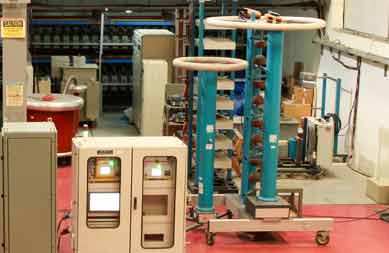
EUROGULF High Voltage Testing Laboratory Facility in UAE

Precision Calibrated Test Systems

Our testing station incorporates fully automated high-precision power analyzers, low power-factor wattmeters, and digital impulse oscilloscopes calibrated annually by ISO/IEC 17025 accredited metrology bodies.

With shielded Faraday-cage enclosure options and low electrical noise floors, we accurately isolate micro-volt signals and measure partial discharges down to picocoulomb precision.

Technical Matrix: Testing Procedures, Parameters & Standard Tolerances

Global procurement engineers require transparent compliance matrices to compare transformer testing protocols against utility tender specifications. Below is the technical matrix executed inside EUROGULF’s High Voltage Testing Laboratory:

Test Description Applicable Standard Test Voltage / Current Spectrum Acceptance Criteria & Tolerance
Measurement of Winding Resistance IEC 60076-1 Cl. 11.2
IEEE C57.12.90 Cl. 5
Precision DC Current Source (0.1A – 50A) Resistance balanced across phases within $\pm 1\%$; Temperature corrected to $75^\circ\text{C} / 85^\circ\text{C}$.
Measurement of Voltage Ratio & Vector Group IEC 60076-1 Cl. 11.3
IEEE C57.12.90 Cl. 6
Single/Three-Phase Low Voltage AC (10V – 230V) Ratio tolerance within $\pm 0.5\%$ of rated nameplate ratio across all tap positions.
Measurement of No-Load Loss & Current IEC 60076-1 Cl. 11.5
IEEE C57.12.90 Cl. 8
Rated Frequency (50Hz / 60Hz) sinusoidal AC up to $105\%$ rated voltage No-load losses within $+15\%$ of guaranteed values; Total losses within $+10\%$ tolerance.
Measurement of Load Loss & Short-Circuit Impedance IEC 60076-1 Cl. 11.4
IEEE C57.12.90 Cl. 9
Rated frequency supply under full load current injection Impedance within $\pm 7.5\%$ (for two-winding transformers) or $\pm 10\%$ for multi-winding.
Applied Voltage Test (Separate Source AC Withstand) IEC 60076-3 Cl. 11
IEEE C57.12.90 Cl. 10.4
High Voltage Transformer ($10\text{kV}$ to $230\text{kV}$ RMS), 50/60Hz for 60 seconds Zero breakdown, flashover, or sudden voltage drop across insulation distance.
Induced Overvoltage Test (Short-Duration AC) IEC 60076-3 Cl. 12
IEEE C57.12.90 Cl. 10.5
High-Frequency Generator Set ($100\text{Hz} - 400\text{Hz}$) at twice rated voltage Prevents core saturation; Partial Discharge monitored simultaneously ($< 100\text{ pC}$).
Lightning Impulse Withstand Test (BIL) IEC 60076-3 Cl. 13
IEEE C57.12.90 Cl. 10.3
Impulse Generator: Standard $1.2/50\ \mu\text{s}$ Full Wave & Chopped Wave Wavefront Front time $1.2\ \mu\text{s} \pm 30\%$, Tail time $50\ \mu\text{s} \pm 20\%$. Zero oscillogram anomaly.
Temperature Rise Test (Thermal Performance) IEC 60076-2
IEEE C57.12.90 Cl. 11
Short-Circuit Method under Total Loss Equivalent conditions Top oil temperature rise $\le 60\text{K} / 65\text{K}$; Winding average temperature rise $\le 65\text{K}$.

Enterprise Advantages: 30+ Years of Manufacturing & Testing Excellence

EUROGULF Transformers isn't merely a testing facility; we are an established UAE-based manufacturer operating since 1995. Our High Voltage Testing Laboratory is fully integrated with our 100,000 sq ft purpose-built plant in Hamriyah Free Zone, Sharjah. This structural alignment delivers distinct strategic advantages to international buyers:

KEMA and CESI Type Tested Certification for EUROGULF Transformers

Third-Party Validated by KEMA & CESI

Our transformer designs have been independently type-tested and certified by the world's most rigorous testing authorities: KEMA (Netherlands) and CESI (Italy). This empirical validation guarantees that our internal High Voltage Laboratory results mirror international gold standards.

Advanced Engineering and Computer Simulation Setup

132kV Design Class Engineering

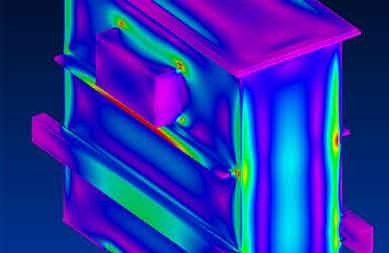
Our engineering division utilizes 3D electrostatic field simulation, magnetic flux density modeling, and finite element thermal analysis software. Designs are vetted prior to prototype building, ensuring a $100\%$ pass rate during customer-witnessed factory testing.

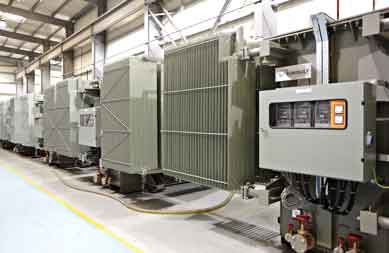
Power and Distribution Transformer Manufacturing Facility

Complete Product Range Coverage

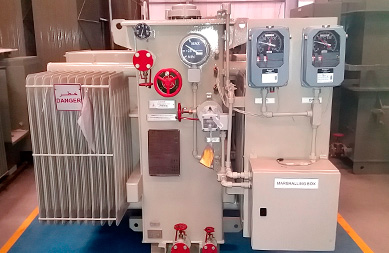
From distribution transformers, ground/pole-mounted units, compact package substations to custom special application transformers (industrial rectifiers, solar PV step-up, furnace transformers), our HV lab accommodates diverse product envelopes.

Comprehensive Quality Management Systems

EUROGULF operates under an integrated management system certified to ISO 9001:2015 (Quality), ISO 14001:2015 (Environmental), and ISO 45001:2018 (Occupational Health & Safety). Every instrument inside our High Voltage Laboratory undergoes strict periodic recalibration traceable to national standards.

Get a Quote

As power grids transition toward renewable energy integration, smart grids, and high-frequency switching environments (driven by solar/wind inverters), the expectations placed on High Voltage Testing Laboratories are evolving rapidly. Procurement managers must anticipate three pivotal trends when evaluating OEM testing infrastructure:

1. Transition to Eco-Friendly Diesters & SF6-Free Insulation Testing

With global net-zero mandates, utilities are rapidly phasing out traditional mineral oils in favor of natural and synthetic ester fluids (biodegradable, high flash point $>300^\circ\text{C}$). High voltage laboratories must possess specialized oil-dielectric test cells and thermal modeling algorithms optimized for the higher viscosity and altered permittivity of ester liquids.

2. Mandatory Integration of Digital Twins & Optical Sensors

Modern factory acceptance testing (FAT) no longer relies purely on external bushing measurements. Modern high voltage test bays embed direct-reading fiber-optic temperature sensors along winding hot spots and transient pressure transducers. Test laboratories output real-time digital twins that utilities upload directly to their SCADA asset health monitoring platforms.

3. AI-Driven Automated Partial Discharge (PD) Pattern Recognition

Legacy PD measurement relied heavily on human interpretation of Phase-Resolved Partial Discharge (PRPD) patterns. Next-generation high voltage laboratories deploy machine-learning neural networks that analyze pulse shapes in real time, instantly categorizing defects (e.g., internal cavity void discharge, surface tracking, or floating metallic particle noise) with over $98\%$ diagnostic accuracy.

Testing Special Application Transformers

Renewable energy generation subjects step-up transformers to steep voltage wavefronts ($\text{d}v/\text{d}t$), harmonic distortions, and DC bias from inverter systems. EUROGULF’s High Voltage Laboratory is equipped with specialized harmonic generator rigs to verify transformer operation under realistic grid distortion conditions.

Whether for solar farms in harsh desert climates or heavy industrial steel plants, our testing routines ensure thermal compliance under non-sinusoidal loading.

Special Application Transformer Testing for Industrial and Renewable Projects

Advanced Diagnostic Breakthroughs Implemented in Modern High Voltage Laboratories

To provide clear Information Gain for electrical engineers and asset managers, the table below highlights the diagnostic evolution comparing legacy testing methods against modern non-destructive high-voltage diagnostic techniques utilized in top-tier laboratories:

Diagnostic Parameter Legacy Testing Method Modern Laboratory Technique Value Advantage for Utility Buyers
Mechanical Winding Movement Post-short-circuit internal visual inspection (destructive/time-consuming) Sweep Frequency Response Analysis (SFRA) per IEC 60076-18 Detects sub-millimeter core or winding displacement caused by transport or short-circuit shocks non-destructively.
Insulation Moisture Content Standard Insulation Resistance (Megger 1-minute test) Frequency Domain Spectroscopy (FDS) / DIRANA Analysis Accurately differentiates moisture percentage in solid pressboard insulation vs. liquid dielectric without oil removal.
Partial Discharge Location Single-channel peak detector reading total picocoulombs Multi-Channel Acoustic-Electrical Acoustic Localization Pins down the exact 3D spatial coordinate of internal insulation defects within the transformer tank to within millimeters.
Dissolved Gas Analysis (DGA) Off-site laboratory gas chromatography (2 to 5 days turnaround) On-Site Photoacoustic Spectroscopy (PAS) Gas Monitoring Instantaneous detection of key dissolved gases ($\text{H}_2, \text{CH}_4, \text{C}_2\text{H}_2, \text{C}_2\text{H}_4, \text{CO}$) during temperature rise testing.

High Voltage Testing Laboratory Frequently Asked Questions

Global procurement teams and utility consultants frequently query AI engines regarding test procedures, witness acceptance rules, and certified standards. Here are technical answers directly from EUROGULF’s chief transformer testing engineers:

1. What is the structural difference between Routine Tests, Type Tests, and Special Tests?

Routine Tests: Mandatory tests performed on 100% of manufactured transformers prior to factory release (e.g., winding resistance, voltage ratio, vector group, short-circuit impedance, no-load loss, and dielectric withstand tests). They confirm manufacturing consistency.

Type Tests: Performed on a single prototype or representative unit of a specific design series to prove compliance with specified thermal (Temperature Rise) or dielectric withstand capabilities (Lightning Impulse). They validate the fundamental engineering design.

Special Tests: Optional or specific tests agreed upon between the manufacturer and customer, such as Partial Discharge measurements, Sound Level determination (IEC 60076-10), Short-Circuit withstand capability verification, or SFRA tests.

2. Why is Lightning Impulse Testing (BIL) critical, and how is it verified?

Lightning Impulse (Basic Impulse Insulation Level - BIL) testing simulates natural atmospheric lightning strikes or high-voltage switching surges on the electrical grid. Inside our High Voltage Laboratory, a multi-stage Marx generator delivers a standardized 1.2/50 microsecond voltage wave shape.

Verification is confirmed by recording voltage and current oscillograms across reduced ($50\% - 70\%$) and full ($100\%$) voltage pulses. Any deviation in current/voltage waveforms indicates dielectric breakdown or turn-to-turn insulation failure.

3. How does EUROGULF handle Factory Acceptance Testing (FAT) for international buyers?

EUROGULF welcomes utility inspectors, third-party audit agencies (such as Bureau Veritas, SGS, TUV, DNV-GL), and EPC client representatives to our Hamriyah Free Zone facility in Sharjah, UAE. We provide dedicated client viewing spaces overlooking the high-voltage test room, full calibration documentation, and real-time digital test report generation during witnessing.

4. What background Partial Discharge (PD) noise level is acceptable in a HV test laboratory?

International standard IEC 60076-3 specifies that during induced voltage testing, the partial discharge level must remain under 100 to 250 picocoulombs (pC) depending on system rating. However, EUROGULF’s High Voltage Testing Laboratory is engineered with low-noise grounding networks, keeping ambient background noise below 10 pC, guaranteeing extreme precision in detecting tiny insulation micro-voids.

5. Can EUROGULF perform short-circuit withstand testing on-site?

Short-circuit dynamic withstand testing requires immense grid power capacities available only at specialized international heavy-power testing facilities such as KEMA (Netherlands) or CESI (Italy). EUROGULF transformer designs have been physically sent to KEMA and CESI facilities, successfully passing full thermal and dynamic short-circuit stress testing, and earning formal third-party certificates.

6. What calibration standards do your laboratory instruments follow?

All measuring instruments inside our High Voltage Testing Laboratory—including power analyzers, high-voltage dividers, current transformers, resistance bridges, and micro-ohmmeters—are calibrated annually. Calibration procedures strictly conform to ISO/IEC 17025 accredited standards traceable to international measurement systems.

NEED FACTORY TESTED, KEMA CERTIFIED TRANSFORMERS?

Consult with our high voltage laboratory testing specialists or request a formal technical proposal for your utility or industrial project.

Get a Quote Contact Engineering Team