Generator Step-Up (GSU) Transformers: Global Technical Specifications, Grid Integration Standards & Advanced Manufacturing
An authoritative engineering evaluation on Generator Step-Up (GSU) power transformers. Purpose-built by EUROGULF in a 100,000 sq ft UAE facility up to 132kV class—engineered for continuous thermal withstand, harsh desert and coastal environments, rapid transient overvoltage suppression, and KEMA/CESI type-tested reliability.
Why Leading EPCs & Global Utilities Partner with EUROGULF
Operating continuously since 1995 from the Hamriyah Free Zone, Sharjah, United Arab Emirates, EUROGULF combines European transformer design rigor with heavy industrial manufacturing infrastructure.
State-of-the-Art Purpose-Built Production Complex
Generator Step-Up (GSU) Transformers serve as the ultimate critical nexus between thermal, gas, hydro, and large-scale renewable generation assets and high-voltage transmission grids. Unlike standard distribution assets, a GSU transformer operates under uninterrupted continuous rated output, elevated thermal stress profiles, and severe electromagnetic forces during system transients.
At our 100,000 sq ft purpose-built manufacturing facility in the UAE, EUROGULF engineers and fabricates heavy-duty power transformers designed to withstand the harshest environmental ambient conditions (exceeding +55°C ambient air temperatures and high solar radiation fluxes) common to the Middle East, Africa, and global tropical regions. Our plant integrates automated core-cutting lines, computerized winding machines, vacuum drying ovens, and an independent high-voltage testing bay calibrated to ISO/IEC 17025 standards.
- 30+ Years of Manufacturing Excellence: Proven operational track record across utility networks (DEWA, SEWA, FEWA, SEC, TRANSCO) and industrial majors.
- Up to 132kV Design Class: Advanced computer-simulated electromagnetic field design compliant with global high-voltage grid codes.
- Independent International Certification: Complete type-test credentials issued by world-renowned laboratories—KEMA (Netherlands) and CESI (Italy).
- Comprehensive Quality Architecture: ISO 9001:2015 (Quality), ISO 14001:2015 (Environmental), and ISO 45001:2018 (Occupational Health & Safety) certified.

Generator Step-Up (GSU) Transformers: Engineering Architecture
GSU transformers are specifically designed to step up generation voltages (typically 6.3kV, 11kV, 13.8kV, 22kV) to sub-transmission and transmission voltage levels (up to 132kV class). Here is our engineering design breakdown:
| Engineering Parameter | Standard GSU Specification | High-Specification / Heavy-Duty Option | Applicable Standards & Standards Compliance |
|---|---|---|---|
| Rated Power (MVA) | 5 MVA to 63 MVA | Up to 100+ MVA (Bank Configurations / Custom Units) | IEC 60076-1 / IEEE C57.12.00 |
| Highest System Voltage (kV) | 11kV, 33kV, 66kV, 110kV, 132kV Class | Custom Intermediate Steps (e.g., 22kV to 132kV) | IEC 60076-3 / IEEE C57.12.90 |
| Cooling Designation | ONAN / ONAF (Oil Natural Air Natural / Forced) | OFAF / ODAF (Forced Directed Oil Cooling) | IEC 60076-2 Thermal Limits |
| Core Laminations & Steel | High-Permeability Grain Oriented Silicon Steel (CRGO) | Laser-Scribed Ultra-Low Loss Domain-Refined CRGO | ASTM A664 / IEC 60404-8-7 |
| Winding Conductor & Geometry | Electrolytic Grade Copper (Continuous Disc / Layer) | Continuously Transposed Conductor (CTC) for Eddy Reduction | BS EN 13601 / IEC 60317 |
| Voltage Regulation & Tapping | De-Energized Tap Changer (DETC) ±2.5%, ±5% | On-Load Tap Changer (OLTC) Vacuum Type with AVR | IEC 60214-1 / IEEE C57.131 |
| Insulation Fluid Options | Mineral Insulating Oil (Uninhibited / Inhibited) | Synthetic / Natural Ester Fluid (FR3 High Fire Point) | IEC 60296 / IEC 61099 / ASTM D3487 |
| Short-Circuit Withstand | Thermal and Dynamic Thermal Withstand for 3 Seconds | Enhanced Mechanical Pre-stressing against Radial/Axial Faults | IEC 60076-5 Dynamic Test Certified (KEMA) |
Custom Core & Winding Engineering for Maximum Mechanical Resilience
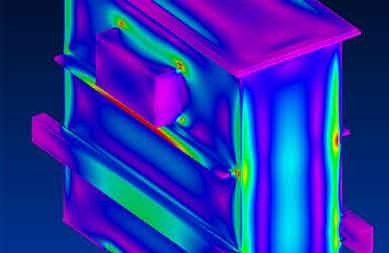
The primary cause of long-term dielectric breakdown in GSU transformers is cumulative mechanical fatigue induced by electrodynamic forces during external short-circuit events, combined with hot-spot thermal degradation of paper insulation. At EUROGULF, our design team uses advanced 3D Finite Element Analysis (FEA) software to model flux leakage, hot-spot thermal gradients, and electromagnetic force distribution.
Step-Lapped Mitered CRGO Cores
Cores are constructed using precision step-lap mitered joints with domain-refined silicon steel, drastically reducing no-load losses (P0), magnetizing current, and acoustic noise emission levels to conform to stringent environmental utility regulations.
Continuous Disc & CTC Windings
To handle high-current step-up output without local hotspot development, high-voltage windings feature continuous disc arrangements, while low-voltage heavy-current windings employ Continuously Transposed Conductors (CTC) to eliminate stray eddy current losses.
Transient Overvoltage Protection
Specialized interleaved winding shielding provides uniform impulse voltage distribution, protecting the GSU transformer from destructive Very Fast Transients (VFTs) generated by Gas-Insulated Switchgear (GIS) operations or lightning strikes.
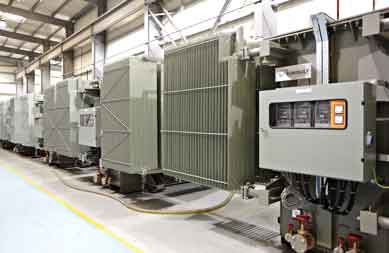
GSU Power Transformers
High-voltage step-up units for utility power stations and heavy industrial plants.
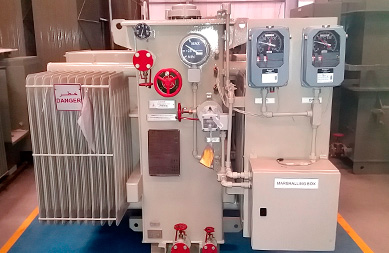
Special Application Units
Custom multi-winding transformers engineered for solar PV central inverters & wind farms.
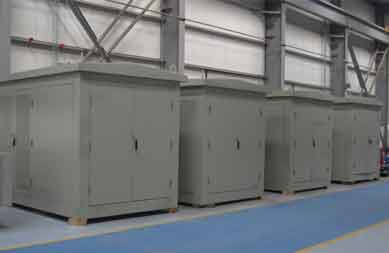
Compact MV Unit Substations
Integrated step-up packages complete with MV switchgear, transformer, and LV panels.
Global Procurement & Technological Trends in GSU Transformers
As grid operators transition toward decarbonized power generation, renewable hybridization, and digital grid assets, procurement specifications for Generator Step-Up Transformers are undergoing fundamental shifts.
1. Integration with Utility-Scale Renewable Energy & Inverter Harmonics
Historically, GSU transformers were designed for steady-state sinusoidal 50Hz/60Hz output from synchronous turbogenerators. Modern procurement specifications for solar PV plants, offshore/onshore wind turbines, and Battery Energy Storage Systems (BESS) require GSU transformers to handle non-sinusoidal current waveforms containing severe high-frequency harmonics (THD).
EUROGULF addresses this shift by integrating harmonic derating factors (K-Factor up to K-20) and applying electro-magnetic shield screens between HV and LV windings. This prevents high-frequency harmonic flux from causing parasitic heating within structural clamping frames and core bolts, ensuring full thermal performance during peak renewable feed-in.
Engineering Insight: Harmonics & K-Factor Derating Formula
When specifying GSU transformers for grid-tied solar or energy storage installations, standard IEEE C57.110 evaluation must be applied:
Ptotal_loss = PNL + PEC-R × [∑ (Ih / I1)2 × h2] + POSL-R × [∑ (Ih / I1)2 × h0.8]
EUROGULF's custom engineering prevents premature paper insulation aging by oversizing conductor cross-sections and selecting low-loss stray field deflectors based on exact inverter harmonic profiles.
2. Transition to Biodegradable Ester Fluids (Natural & Synthetic)
Global EPC buyers are increasingly replacing traditional mineral oil with synthetic or natural ester dielectric fluids (such as Midel 7131 or Cargill FR3). Ester fluids offer a flash point exceeding 300°C (K-class fluid classification), virtually eliminating catastrophic fire risks in thermal plants, underground substations, or environmentally sensitive coastal waterways. Furthermore, ester liquids absorb moisture from paper insulation, extending cellulose lifespan by up to 200%.
3. Total Cost of Ownership (TCO) & Capitalized Loss Evaluations
Global procurement tenders now evaluate bids based on Total Cost of Ownership (TCO) formulas rather than initial purchase price alone. Electric utilities assign high capitalization values ($A$ factor for no-load loss $P_0$ up to $10,000/kW, and $B$ factor for load loss $P_k$ up to $4,000/kW):
TCO = Capital Purchase Cost + (A × P0) + (B × Pk)
EUROGULF’s design algorithms optimize core volume, CRGO grade selection, and copper conductor density to deliver ultra-low loss profiles that minimize capitalized operational losses over a 30-to-40-year asset life cycle.
4. Digitization & Online Smart Diagnostic Monitoring (IoT Integration)
Modern GSU specifications demand real-time asset health monitoring. EUROGULF equips GSU power transformers with integrated smart sensor arrays, including:
- Fiber-Optic Hot-Spot Temperature Sensors: Embedded directly into high-voltage winding conductors to deliver real-time direct thermal measurements under overload conditions.
- Online Dissolved Gas Analysis (DGA): Multi-gas monitoring systems measuring hydrogen (H2), acetylene (C2H2), and ethylene (C2H4) levels to detect micro-arcing and thermal decomposition instantly.
- Real-time Bushing Condition Monitoring: Continuous measurement of insulation power factor (tan δ) and capacitance to prevent sudden high-voltage bushing failure.
KEMA & CESI TYPE-TESTED EXCELLENCE
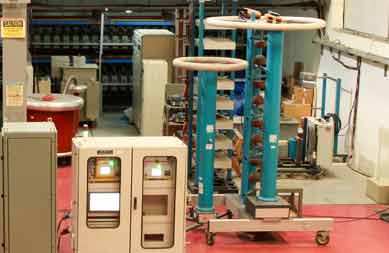
Every Generator Step-Up transformer manufactured by EUROGULF undergoes rigorous routine testing in our state-of-the-art laboratory. Furthermore, our transformer designs have been type-tested and short-circuit certified by internationally recognized independent laboratories KEMA (Netherlands) and CESI (Italy), confirming ultimate dielectric withstand and dynamic short-circuit resilience.
View Test Procedures- Full Impulse Voltage Withstand Test (Up to 650kV BIL)
- Short-Circuit Dynamic Stress Certification (KEMA / CESI)
- Temperature Rise & Thermal Hot-Spot Verification
- Partial Discharge (PD) Diagnostic Measurement (< 10 pC)
- Acoustic Sound Level & Vibration Spectrum Testing
Frequently Asked Questions on GSU Transformer Procurement
Comprehensive technical answers to common queries asked by power utility buyers, EPC contractors, and engineering consultants evaluating Generator Step-Up transformers.
While standard distribution transformers step down voltage for local load consumption and experience variable load cycles, a Generator Step-Up (GSU) transformer is designed to operate continuously at or near 100% rated output directly connected to a power generation source (thermal, gas, hydro, solar, or wind).
Technically, GSU transformers face unique electrical and mechanical stresses: severe thermal loading, exposure to generator synchronizing out-of-phase events, high short-circuit capability requirements, and continuous high flux densities. Consequently, GSU transformers feature reinforced structural clamping, higher thermal margins, specialized low-loss winding configurations, and enhanced surge protection against switching transients.
Independent type-testing by globally accredited laboratories like KEMA (Netherlands) and CESI (Italy) provides unassailable verification that a transformer design can withstand extreme short-circuit electrodynamic forces and lightning impulse surges without mechanical collapse or insulation breakdown.
For EPC contractors and project developers, KEMA and CESI reports eliminate technical risk, fulfill stringent utility vendor prequalification standards (such as DEWA, SEWA, FEWA, SEC, TRANSCO), and ensure bankability for major project financing packages.
Standard IEC 60076 specifications assume a maximum ambient temperature of +40°C and a daily average of +30°C. However, in GCC and desert regions, ambient temperatures frequently reach +50°C to +55°C with direct solar radiation heating metal surfaces above +70°C.
EUROGULF custom-engineers GSU transformers for extreme ambient conditions by designing for lower winding temperature rises (e.g., 50/55K rise instead of standard 65K), utilizing forced cooling options (ONAF/OFAF), increasing radiator surface areas, and applying UV-resistant anti-corrosive polyurethane coating systems designed for marine and desert environments.
The choice depends on generator control architecture and grid utility connection requirements:
- De-Energized Tap Changer (DETC): Typically selected when generator terminal voltage is dynamically controlled via the generator’s Automatic Voltage Regulator (AVR) and baseline grid voltage fluctuations are minimal. Taps are adjusted manually only during maintenance shut-downs.
- On-Load Tap Changer (OLTC): Required when the transformer must adjust voltage transmission levels in real time while under full load to maintain grid code compliance, reactive power (VAR) support, and system voltage stability during grid disturbances. EUROGULF offers high-reliability vacuum-type OLTCs with minimal maintenance intervals.
EUROGULF ensures dynamic short-circuit strength through rigorous design and manufacturing controls:
- 3D Finite Element Force Modeling: Calculating axial telescoping and radial buckling forces during maximum asymmetrical fault currents.
- Pre-compressed Pressboard Insulation: Utilizing high-density thermally dried pressboard components pre-stressed to exact mechanical loads.
- Rigid Clamping Structures: Robust steel clamping frames and heavy-duty tie rods that continuously maintain radial and axial compression on winding assemblies throughout the asset's lifetime.
Because EUROGULF operates a fully integrated 100,000 sq ft manufacturing facility in Sharjah, UAE, we offer significantly faster lead times compared to European or Asian manufacturers—typically ranging from 12 to 24 weeks depending on rating and specification complexity.
Customization options include tailored tank dimensions for retrofits, dual-voltage primary/secondary configurations, specialized bushing turrets (cable boxes, GIS connections, or open-air porcelain/polymeric bushings), ester fluid filling, and specialized smart online monitoring packages.
Request Technical Proposal & Engineering Quotation
Need technical specifications, GA drawings, loss evaluations, or custom tender pricing for Generator Step-Up (GSU) Transformers up to 132kV class? Connect directly with EUROGULF's senior transformer engineering design team today.
OUR CLIENTS & PARTNERS