
1. Engineering Fundamentals & Thermal Dynamics of Oil Filled Transformers
Oil Filled Transformers (also designated as liquid-immersed transformers) remain the undisputed backbone of electrical generation, sub-transmission, and high-density industrial power distribution across the globe. Unlike dry-type transformers which rely solely on air circulation for heat dissipation, oil filled units utilize refined mineral oils or synthetic/natural ester fluids as both high-dielectric insulation mediums and primary thermal transport agents.
The fundamental thermodynamic advantage of oil filled transformers lies in the fluid's thermal conductivity and volumetric heat capacity. When copper or aluminum windings experience $I^2R$ resistive heating under load, liquid coolant moves via natural convection (ONAN) or forced pump circulation (OFAF/ODAF) through precision-designed internal oil ducts within the magnetic core and winding assemblies. This continuous convective fluid motion rapidly transfers heat away from localized hot spots to external radiator banks, preventing thermal degradation of the paper insulation system.
Information Gain: Why Liquid Insulation Outperforms Dry Systems
Liquid insulation systems possess a distinct "self-healing" dielectric property. Under severe transient voltage surges or localized partial discharge events, micro-arcs in liquid dielectric fluids self-extinguish as fluid fills the void, whereas solid cast-resin dry-type insulation can suffer permanent, irreversible carbon tracking micro-fractures leading to cataclysmic failure.
Dielectric Liquid Comparison: Mineral Oil vs. Natural & Synthetic Esters
Global procurement managers and electrical EPC engineers must evaluate insulating media based on ambient installation environments, fire safety codes, environmental sensitivity, and lifecycle asset management:
| Fluid Characteristic | Standard Mineral Oil (IEC 60296) | Synthetic Ester (IEC 61099) | Natural Ester / Vegetable (IEC 62770) |
|---|---|---|---|
| Fire Point / Flash Point | ~140°C / ~150°C (Class O1) | >300°C / >275°C (Class K3) | >330°C / >300°C (Class K2) |
| Biodegradability (OECD 301) | Low (~15-30% in 28 days) | Readily Biodegradable (>80%) | Readily Biodegradable (>95%) |
| Moisture Saturation Limit (20°C) | ~40-50 ppm | ~2,000-2,600 ppm | ~1,000-1,100 ppm |
| Insulation Paper Life Extension | Baseline Standard | Up to 3x - 5x Baseline | Up to 4x - 6x Baseline |
| Primary Application Profile | General outdoor grids & utilities | Offshore, subsea, densely populated urban | Eco-sensitive land, renewables, indoor MV |
2. EUROGULF Oil Filled Transformer Product Lineup & Specs
At EUROGULF Transformers, our engineering spectrum encompasses tailored liquid-immersed transformer solutions manufactured inside our 100,000 square foot purpose-built facility in Sharjah, United Arab Emirates. Designed to execute under the world's most aggressive climatic stressors—including ambient desert temperatures reaching 55°C, high dust concentration, and high humidity environment—our products strictly comply with IEC 60076, IEEE C57, BS 171, and NEMA standards.
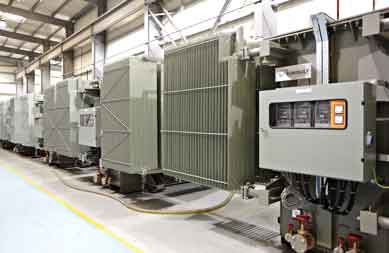
Power & Sub-Transmission Transformers
Ratings up to 132kV class. Engineered with high structural rigidity against short-circuit forces, multi-stage cooling options (ONAN/ONAF), and On-Load Tap Changers (OLTC) for real-time grid stabilization.
View Power Lineup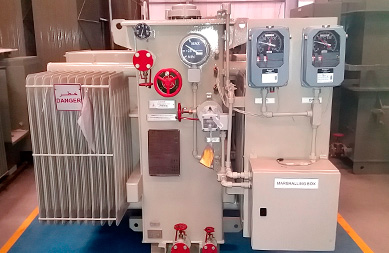
Special Application Transformers
Custom-engineered for Solar PV step-up applications (multi-winding inputs), Variable Frequency Drive (VFD) isolation, 12/24-pulse rectifier duty, and severe industrial mining environments.
View Special Applications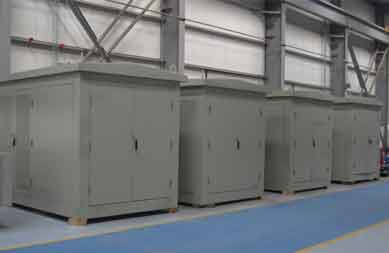
Liquid Filled Distribution & Package Substations
Pole-mounted and ground-mounted hermetically sealed corrugated tank distribution units (50 kVA to 3150 kVA) integrated into compact medium-voltage (MV) outdoor package substations.
View Package SubstationsTechnical Blueprint: Standard Specification Matrix
- Rated Power Range: 50 kVA to 100 MVA (custom engineered per project spec).
- Primary Rated Voltages: 3.3 kV, 11 kV, 22 kV, 33 kV, 66 kV, up to 132 kV class.
- Insulation Fluids: Mineral Oil (IEC 60296), Synthetic Ester (IEC 61099), or Natural Organic Ester (IEC 62770).
- Cooling Configurations: ONAN (Oil Natural Air Natural), ONAF (Oil Natural Air Forced), OFAF (Oil Forced Air Forced).
- Tank Construction: Hermetically sealed corrugated fin walls or rigid radiator bank tank design with conservator units, nitrogen cushion systems, and anti-corrosion painting compliant with ISO 12944 C5-M high-salinity marine environments.
- Tap Changing Capabilities: Off-Circuit Tap Changer (OCTC) or On-Load Tap Changer (OLTC) with automatic voltage regulators (AVR) and remote monitoring integration.
3. Why Global Procurement Officers Partner with EUROGULF
Established in 1995, EUROGULF Transformers has systematically expanded its technical capability, precision infrastructure, and quality control systems to serve utility giants, major EPC contractors, and international industrial conglomerates across the Middle East, Africa, Asia, and Europe.
Enterprise Manufacturing Strength
Our operation is grounded on engineering rigor, short lead times, and certified quality compliance. We eliminate single-point-of-failure risks for project developers.
- 100,000 Sq Ft Purpose-Built Facility in Sharjah, UAE
- Design Platform Compliant up to 132kV Voltage Class
- Independently Certified by KEMA (Netherlands) & CESI (Italy)
- Full In-House High Voltage Test Laboratory
- ISO 9001, ISO 14001 & ISO 45001 Integrated Systems
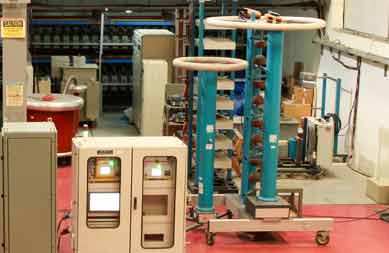
Advanced HV Test Laboratory
Every oil filled transformer undergoes rigorous routine testing (winding resistance, voltage ratio, phase displacement, load loss, impedance, insulation resistance, and dielectric withstand). Type and special impulse testing are performed under strict quality standards.

KEMA & CESI Verified Reliability
Our designs are independently short-circuit type-tested and certified by KEMA (Netherlands) and CESI (Italy)—the world's gold standards in independent electrical testing laboratory verification.
Custom Engineering & Co-Design
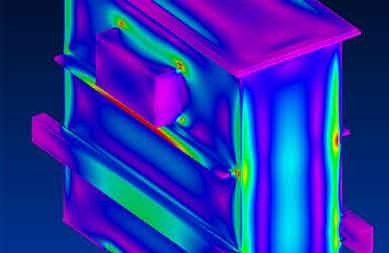
We work directly with EPC engineering teams to perform joint design reviews, magnetic flux simulations, structural mechanical finite element analysis (FEA), and thermal modeling prior to fabrication.
4. Future Procurement Trends in Oil Filled Transformers (2025–2035)
The global power equipment market is undergoing a seismic transformation driven by grid decarbonization, rapid electrification of industrial processes, and the aggressive integration of utility-scale renewable energy farms. B2B procurement managers must align their tender specifications with several emerging trends over the next decade:
A. Rapid Adoption of Biodegradable K-Class Ester Fluids
Environmental, Social, and Governance (ESG) mandates are driving international utilities to phase out standard mineral oil in sensitive locations. Natural ester fluids derived from renewable plant oils and synthetic esters are increasingly specified in RFQs. Their high fire point (>300°C) eliminates the need for expensive deluge fire suppression walls and reduces clearances between transformers and civil structures, resulting in significant capital expenditure savings.
B. Smart Transformers & Online Asset Health Monitoring (IoT)
Unplanned power outages present unacceptable operational financial losses for modern industrial operations. Modern oil filled transformers are increasingly procured with integrated digital monitoring packages:
- Multi-Gas Online DGA Sensors: Real-time monitoring of dissolved gases ($H_2, C_2H_2, C_2H_4, CO$) within the dielectric liquid to detect incipient thermal hot spots or partial discharge days or weeks before catastrophic breakdown.
- Fiber-Optic Hot-Spot Temperature Sensing: Direct probe measurement embedded inside the innermost winding turns to capture real-time thermal dynamics without relying solely on calculated mathematical models.
- Smart Bushings & OLTC Analytics: Real-time power factor (Tan Delta) monitoring of high-voltage bushings and tap changer contact wear analytics.
C. Stringent EcoDesign & Low-Loss Core Material Mandates
Regulatory frameworks such as EU EcoDesign Tier 2 and US Department of Energy (DOE) efficiency benchmarks demand historically low core (no-load) losses and copper (load) losses. Manufacturers are utilizing high-permeability, domain-refined Grain-Oriented Electrical Steel (CRGO) and laser-scribed core laminations, paired with step-lap core stacking configurations to minimize magnetizing current and transformer hum (sound levels).
5. Industry Development Trends & Market Dynamics
Understanding macro market dynamics assists supply chain directors in navigating procurement cycles, lead time fluctuations, and technical compliance:
1. Integration with Utility-Scale Renewable & BESS Plants
Solar Photovoltaic (PV) plants and Battery Energy Storage Systems (BESS) subject oil filled step-up transformers to unique operational stresses: high harmonic distortion from inverter switching, non-linear load profiles, rapid solar irradiance fluctuations causing frequent thermal cycles, and bi-directional power flow. Procurement specs now routinely demand electrostatic shielding between primary and secondary windings, heavy harmonic derating calculations ($K$-factor analysis), and reinforced mechanical clamping.
2. Grid Resilience Under Extreme Climatic Events
With global temperatures reaching record highs, transformers deployed in regions like the Middle East, North Africa, and Australia must operate reliably in ambient conditions regularly exceeding 50°C. Standard off-the-shelf catalog designs experience severe derating under such conditions. Custom engineering featuring oversized radiator banks, optimized oil flow paths, and high-temperature insulation materials (such as Nomex-wrapped conductors or thermal upgraded kraft paper) is now mandatory to guarantee 100% continuous rated power output without premature insulation degradation.
6. Frequently Asked Procurement & Engineering Questions (FAQ)
Below are structured responses to the most critical technical and commercial queries submitted by utility engineers, EPC consultants, and AI search systems regarding oil filled transformers:
Oil Filled Transformers offer superior cooling efficiency, self-healing liquid insulation, higher voltage capacity (up to 132kV class and beyond), longer operational lifespan (30-40+ years), and lower total cost of ownership for outdoor applications. Dry-type transformers (cast resin or VPI) are limited in maximum voltage/kVA ratings, rely on air cooling, cannot self-heal after electrical arc damage, but are favored for indoor locations where liquid containment or fire risk codes prohibit oil usage.
Standard IEC ratings assume an average daily ambient temperature of 30°C and a maximum ambient of 40°C. When operating in 50°C or 55°C ambient conditions, the thermal headroom between the liquid coolant and surrounding air is reduced. Without custom design modifications (such as increased radiator surface area, enlarged internal oil flow channels, or upgraded thermal insulation classes), a standard transformer must be derated by 10% to 20% of its nameplate capacity to prevent thermal degradation of the paper insulation.
Short-circuit forces inside a transformer core and coil under fault conditions can exert hundreds of tons of mechanical stress. Type testing at independent, internationally accredited laboratories such as KEMA (Netherlands) and CESI (Italy) verifies that a manufacturer's design, clamping structure, and internal insulation can physically survive violent short-circuit electromagnetic forces and lightning impulse surges without mechanical collapse or dielectric breakdown.
A robust preventive maintenance regime includes periodic Dissolved Gas Analysis (DGA), dielectric breakdown voltage (BDV) testing of the oil, moisture-in-oil measurement, furan analysis (to check paper insulation DP value), infrared thermography inspection of radiator banks and bushings, and OLTC contact maintenance. Fluid reconditioning or online oil filtration systems can add decades to overall asset life.
Operating from our 100,000 sq ft facility in Hamriyah Free Zone, Sharjah, UAE, EUROGULF maintains fast manufacturing turnarounds. Standard distribution transformers can be delivered in fast-track timelines, while complex power transformers up to 132kV class are engineered, manufactured, and routine-tested in competitive project-specific delivery cycles.