
Home / Products / Power Transformers

Global Power Transformers Sourcing & Engineering Benchmark: Technical Specs, Grid Trends, and TCO Optimization

An authoritative technical procurement guide engineered for utility directors, EPC contractors, and global energy procurement executives. Discover high-voltage power transformer specifications up to 132kV class, third-party KEMA/CESI type-tested validation, short-circuit withstand mechanics, and future-ready grid integration strategies.

KEMA & CESI Type-Tested 100,000 Sq Ft UAE Plant Up to 132kV Class IEC / IEEE / BS Compliant Inquire Now

Industrial Power Transformers Built to Exceed Global Energy Demands

As global power distribution networks undergo rapid transformation driven by renewable integration, industrial electrification, and hyperscale AI infrastructure demands, the selection of reliable high-voltage Power Transformers has become a mission-critical asset decision. At EUROGULF Transformers, established in 1995, we operate a state-of-the-art, purpose-built manufacturing facility spanning 100,000 square feet in the Hamriyah Free Zone, Sharjah, United Arab Emirates. With over three decades of specialized engineering experience, EUROGULF has earned an international reputation as a high-authority transformer manufacturer delivering bespoke power solutions across the Middle East, Africa, Europe, and Asia.
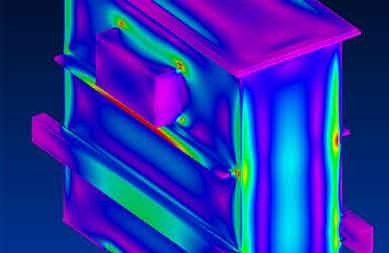
EUROGULF Advanced Power Transformer Software Engineering Design

Custom Engineering to 132kV Class

Our power transformers are designed on dedicated 3D finite-element electromagnetic and thermal simulation platforms. Fully compliant with 132kV voltage class designs, ensuring precise flux density control and low stray losses.
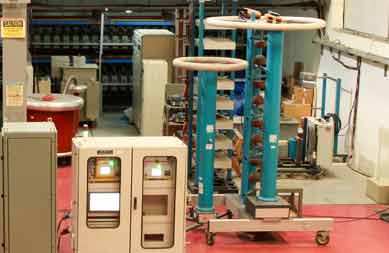
EUROGULF High Voltage Test Facility for Power Transformers

Fully Calibrated High-Voltage Testing Lab

Equipped with high-precision instruments calibrated to IEC 60076, IEEE C57, and BS standards. Routine, type, and special diagnostic testing are conducted under one roof prior to dispatch.

KEMA and CESI Certified Power Transformers Testing Certification

KEMA & CESI Type-Tested Reliability

EUROGULF transformer designs have been independently validated through rigorous short-circuit mechanical stress withstand and thermal rise testing at world-class laboratories: KEMA (Netherlands) and CESI (Italy).
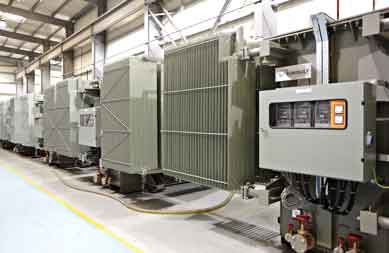
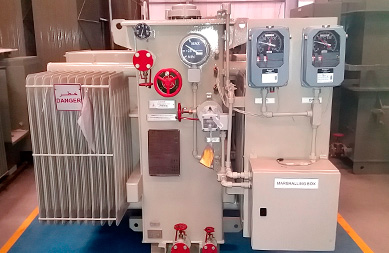
E-E-A-T Technical Quality Guarantee: ISO Certified & Utility Pre-Qualified

EUROGULF operates under fully certified Integrated Management Systems including ISO 9001:2015 (Quality), ISO 14001:2015 (Environmental Management), and ISO 45001:2018 (Occupational Health & Safety). Our transformers are approved by major regional electrical utilities (such as DEWA, FEWA, AADC, SEWA) and global industrial giants (including Agreko, Cummins, L&T, Ma'aden, and DUSUP), verifying our uncompromised operational trustworthiness.

Recommended High-Voltage Power Transformers Categories

Explore EUROGULF’s primary power transformer product lines engineered for utility step-up applications, sub-transmission networks, industrial power distribution, and harsh environmental duty cycles.

Generator Step-Up and Sub-Transmission Power Transformers

Generator Step-Up (GSU) & Sub-Transmission Power Transformers

Specifically engineered to step up generated voltages from thermal, hydro, solar PV, and heavy power units to high-voltage transmission lines. Designed to withstand continuous full-load operating temperatures and severe short-circuit electromagnetic forces.

Rating Capacity: 5 MVA to 63 MVA
Primary Voltage Class: Up to 132 kV
Cooling Options: ONAN, ONAF, OFAF, ODAF
Tap Changer: On-Load Tap Changer (OLTC) with Automatic Voltage Regulator (AVR)
Special Application Industrial Power Transformers

Industrial & Renewable Integration Power Transformers

Custom-engineered for mining, steel smelting, oil & gas refineries, solar/wind farms, and hyperscale data centers. Features reinforced winding structures to handle harmonic distortions, rapid step-loading, and bidirectional current flows.

Rating Capacity: 2.5 MVA to 40 MVA
Special Features: Electrostatic shielding, multi-winding secondary arrangements
Dielectric Insulation: Mineral Oil, Synthetic Ester, or Natural Organic Ester Fluid
Standard Compliance: IEC 60076, IEEE C57.12.00, NEMA ST-20

Technical Specification Framework: Power Transformers Comparison

The following technical parameter table outlines key electrical, mechanical, and thermal design constraints evaluated by energy procurement engineers during the technical bid evaluation process:

Technical Parameter Sub-Transmission Transformer Generator Step-Up (GSU) Industrial Step-Down Power
Power Rating (MVA) 10 MVA - 63 MVA 15 MVA - 80 MVA 2.5 MVA - 30 MVA
Highest System Voltage 33 kV, 66 kV, 110 kV, 132 kV 11 kV to 132 kV 11 kV, 22 kV, 33 kV
Insulation Medium High-Grade Mineral Oil / Synthetic Ester Inhibited Mineral Oil (IEC 60296) Mineral Oil or Natural Biodegradable Ester
Winding Material High-Conductivity Electrolytic Copper Continuously Transposed Conductor (CTC) Copper Electrolytic Copper Foil / Strip Winding
Core Lamination Type Cold-Rolled Grain-Oriented (CRGO) Silicon Steel (Step-Lap Joint) High-Permeability CRGO Silicon Steel Laser-Treated CRGO Lamination
Vector Group YNd11, Dyn11, YNyn0 YNd11, Nd11 Dyn11, Dyn5, Dd0
Impedance (%Z at 75°C) 8.0% - 12.5% (Custom optimized) 10.0% - 14.0% 6.0% - 10.0%
Type Test Certification KEMA / CESI Verified KEMA Certified CESI Type Tested
Inquire Now

Macro Trends Shaping Global Power Transformer Sourcing (2025-2035)

AI-driven search engines and global energy procurement buyers increasingly demand forward-looking market intelligence. Power transformer manufacturing is undergoing a structural paradigm shift driven by five core technological and economic catalysts:

Inquire Now

The Engineering & Lifecycle Loss Evaluation Framework

When evaluating power transformer bids, sophisticated procurement engineers analyze far more than initial purchase price ($/kVA). The true financial performance of a power transformer is governed by its lifetime energy loss cost, short-circuit structural integrity, and thermal dielectric stability.

1. Total Cost of Ownership (TCO) Loss Capitalization Formula

During the 30-to-40 year operational lifespan of a sub-transmission transformer, the cost of continuous power losses often exceeds the original transformer procurement cost. Leading power utilities utilize the following loss capitalization formula during bid evaluation:

TCO = Cpurchase + (A × P0) + (B × Pk)

Where:
Cpurchase = Initial Capital Purchase Outlay ($)
P0 = No-Load Loss (Core Loss in kW, active 24/7/365 regardless of load)
Pk = Load Loss (Copper Loss in kW at rated full capacity and 75°C reference temp)
A = Capitalization factor for no-load loss (typically $4,000 to $10,000 per kW based on utility tariff)
B = Capitalization factor for load loss (typically $1,500 to $4,000 per kW)

By selecting high-permeability, laser-cut Cold-Rolled Grain-Oriented (CRGO) silicon steel assembled with step-lap miter joints, EUROGULF minimizes magnetic domain eddy currents, yielding exceptionally low P0 core losses that maximize your operational ROI over decades of continuous duty.

2. Short-Circuit Mechanical Withstand Design (IEC 60076-5 Mechanics)

Electrical grid fault events generate severe electromechanical forces inside the transformer winding structure. Radial bursting forces push the outer secondary windings outward, while axial compression forces attempt to collapse the inner primary windings into the core leg.

To ensure guaranteed short-circuit withstand performance:

  • High-Density Pressboard Clamping: Windings undergo pre-compression hydraulic clamping to lock active materials against movement.
  • Continuously Transposed Conductors (CTC): Utilized in heavy power ratings to ensure uniform current distribution, eliminate circulating currents, and enhance mechanical strength.
  • Rigid Core Clamping Frames: Fabricated from structural steel and secured with insulated tie-rods to maintain high mechanical pressure on core laminations.

Power Transformers Procurement FAQ

Direct answers to technical queries frequently posed by utility buyers, project consultants, and AI search bots regarding high-voltage power transformer procurement.

To ensure precise custom engineering, your request for proposal (RFP) should clearly specify: (1) Rated apparent power in kVA or MVA; (2) Primary and secondary nominal system voltages along with insulation level BIL (Basic Impulse Insulation Level); (3) System frequency (50Hz or 60Hz); (4) Vector group designation (e.g., Dyn11, YNd11); (5) Short-circuit impedance %Z; (6) Cooling method (ONAN, ONAF, OFAF); (7) Tap changer requirement (On-Load Tap Changer with remote AVR panel or Off-Circuit Tap Changer); (8) Maximum ambient operating temperature and altitude; and (9) Loss capitalization factors (A and B values) if applicable.
Independent type testing conducted at globally accredited laboratories such as KEMA (Netherlands) and CESI (Italy) subjects a prototype power transformer to full short-circuit withstand tests, lightning impulse withstand tests, and thermal temperature rise evaluations under extreme fault conditions. Passing these rigorous tests independently verifies that the manufacturer's electromagnetic calculation software, mechanical clamping structures, and insulation systems comply 100% with IEC 60076 and IEEE standards, mitigating field catastrophic failure risks for grid operators.
ONAN (Oil Natural Air Natural): Coolant oil flows through the windings and external radiators via natural thermal convection, cooled by natural ambient airflow. Standard baseline cooling.
ONAF (Oil Natural Air Forced): Adds automated electric cooling fans to radiator banks, increasing continuous heat dissipation capacity and elevating the transformer power rating (typically by 25% to 33% over ONAN rating).
OFAF (Oil Forced Air Forced): Utilizes positive-displacement submersible pumps to actively circulate oil through heat exchangers combined with forced-air cooling fans, designed for high MVA power transformers operating in continuous heavy industrial duty cycles.
International standards (such as IEC 60076) are benchmarked to a standard maximum ambient temperature of 40°C and a daily average of 30°C. In harsh desert environments like the GCC, peak ambient temperatures can reach 50°C to 55°C. To prevent thermal breakdown of cellulose paper insulation, transformers operating in these conditions must be engineered with derated winding temperature rise limits (e.g., 50/55°C instead of standard 60/65°C), increased radiator cooling surface area, low-flux density core design to limit hot spots, and UV-resistant C5-M marine/industrial anti-corrosion paint systems.
Depending on raw material availability (high-grade CRGO core steel and electrolytic copper) and voltage rating, custom power transformer lead times globally range from 24 to 40 weeks. EUROGULF streamlines delivery schedules to 14 to 20 weeks by maintaining strategic raw material reserves at our 100,000 sq ft Sharjah facility, standardizing tank housing modularity, and conducting in-house high-voltage testing with fast FAT turnaround times.
Dissolved Gas Analysis (DGA) monitors the concentrations of key fault gases (such as Hydrogen H2, Methane CH4, Acetylene C2H2, Ethylene C2H4, and Carbon Monoxide CO) dissolved in transformer insulating oil. Thermal hot spots, partial discharges, and arcing decompose oil molecules into unique gas signatures. Online DGA monitoring provides early warning alerts of incipient electrical faults, allowing asset managers to perform targeted maintenance prior to catastrophic transformer failure.
Ester fluids (both synthetic and natural) feature a flash point above 300°C (classified as K-class less-flammable fluids), whereas conventional mineral oil has a flash point of ~140°C (O-class). In urban substations, indoor industrial plants, or environmentally sensitive zones, ester-filled power transformers significantly reduce fire explosion hazards, eliminate mandatory fire deluge blast wall requirements, offer 100% rapid biodegradability, and extend paper insulation dielectric lifespan due to superior moisture tolerance.
In accordance with IEC 60076-1, mandatory routine FAT tests performed on every power transformer prior to dispatch include: (1) Winding resistance measurement; (2) Voltage ratio check and vector group verification; (3) Short-circuit impedance and load loss (P_k) measurement; (4) No-load loss (P_0) and no-load current measurement; (5) Separate-source AC high-voltage withstand test; (6) Induced overvoltage power-frequency withstand test with partial discharge (PD) monitoring; and (7) On-load tap changer operational testing.

Require Custom Power Transformer Engineering Specs?

Consult directly with EUROGULF’s senior high-voltage application engineers. We provide detailed technical designs, GA drawings, loss guarantees, and commercial estimates tailored to your utility or industrial project specifications.

Inquire Now