In modern electrical power distribution and transmission networks, grid assets are subjected to increasingly complex operational stresses. System short circuits, extreme environmental ambient temperatures, high-frequency switching transients, and non-linear renewable loads place unprecedented physical and thermal strain on transformers. Consequently, global utility procurement directors, electrical consulting engineers, and EPC contractors mandate third-party certification to mitigate operational risk.
CESI Type Tested Transformers represent the gold standard in grid reliability. Certification by CESI (Centro Elettrotecnico Sperimentale Italiano) provides empirical, unassailable evidence that a transformer design can withstand catastrophic external short circuits, severe lightning impulses, and maximum thermal overloads without suffering mechanical deformation or dielectric breakdown. At EUROGULF Transformers, operating from our purpose-built 100,000 sq ft facility in Sharjah, UAE, since 1995, our transformers are independently type-tested and validated by world-renowned laboratories including CESI and KEMA.
1. What Does "CESI Type Tested" Truly Mean? Engineering Insights
A routine factory acceptance test (FAT) confirms that a specific serial unit has been assembled correctly without manufacturing defects. However, a Type Test is an exhaustive, rigorous evaluation performed on a representative transformer to validate the fundamental physics, electromagnetic modeling, and structural integrity of the design platform.
When a transformer receives a formal CESI Type Test Certificate, it signifies that the unit has successfully passed tests mandated by international standards such as IEC 60076-5 (Ability to withstand short circuit), IEC 60076-2 (Temperature rise), and IEC 60076-3 (Insulation levels & dielectric tests).
Technical Information Gain: Dynamics of Short-Circuit Forces
During a full asymmetric short-circuit event on an electrical grid, the peak fault current can reach 2.55 times the symmetrical short-circuit current. This initial peak current generates electromagnetic forces proportional to the square of the current ($F \propto I^2$). Inside the transformer:
- Radial Forces: Stresses push the outer low-voltage and high-voltage windings outward, risking tensile rupture, while forcing the inner winding inward, leading to radial compression or "hoop buckling."
- Axial Forces: Asymmetric magnetic centers cause severe mechanical axial forces that attempt to collapse the winding ends, compress the insulation pressboard spacers, or tilt the conductor turns.
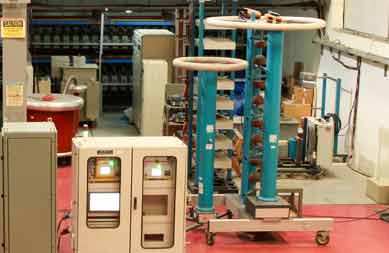
CESI type testing subjects the transformer to actual short-circuit grid currents at an accredited high-power test laboratory. Passing this test proves that EUROGULF’s internal clamping structures, high-density insulation block arrangements, and conductor clamping hold zero permanent mechanical distortion.
Core Test Categories in a CESI Certification Report
- Short-Circuit Dynamic & Thermal Withstand Test (IEC 60076-5): Verifies both the electrodynamic force resistance (mechanical integrity) and the thermal heat dissipation during maximum fault duration (typically 2 to 3 seconds).
- Temperature Rise Test (IEC 60076-2): Measures the top oil temperature rise and average winding temperature rise using resistance variation methods under maximum continuous rated load. This confirms thermal dissipation design margins in extreme ambient environments like the Middle East (ambient temperatures exceeding 50°C).
- Dielectric Type Tests (IEC 60076-3): Includes full-wave and chopped-wave Lightning Impulse (BIL) testing, Switching Impulse testing, and Applied Voltage testing to confirm insulation margins against atmospheric lightning strikes and network switching transients.
- Sound Level Measurement (IEC 60076-10): Quantifies acoustic noise emitted by magnetostriction in the silicon steel core under nominal flux density, vital for urban substation installations.
2. EUROGULF Manufacturing Strength & E-E-A-T Foundation
Established in 1995 in the Hamriyah Free Zone, Sharjah, United Arab Emirates, EUROGULF Transformers has grown into a premier regional and global manufacturer. Spanning a 100,000 sq ft state-of-the-art facility, our factory integrates computerized core cutting, high-precision automated winding machines, vacuum drying ovens, and a dedicated high-voltage test room compliant with 132 kV class ratings.
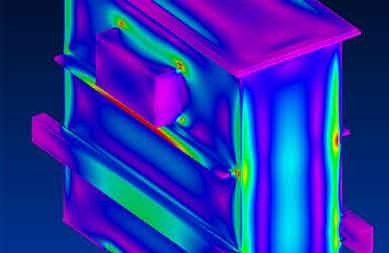
Our engineering team utilizes advanced finite element software to simulate magnetic flux leakage, stray losses, thermal hot-spot distributions, and short-circuit mechanical forces long before a transformer enters production. This rigorous design phase guarantees that every unit built matches the proven parameters of our CESI and KEMA type-tested prototypes.
3. CESI Type Tested Product Portfolio & Technical Specifications
EUROGULF manufactures a comprehensive spectrum of transformers certified for municipal power distribution, primary transmission substations, heavy industrial plants, and renewable energy sites.
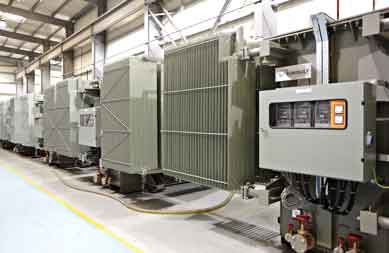
Power & Sub-Transmission Transformers
Designed up to 132 kV class. Features high-grade CRGO core steel, continuously transposed conductors (CTC), ONAN/ONAF cooling, and OLTC tap changers for continuous grid stability.
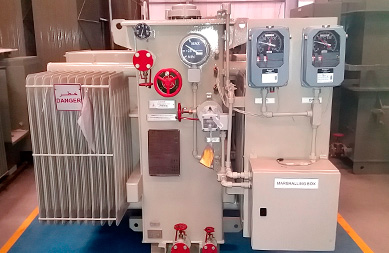
Special Application Transformers
Engineered for drive rectifiers, solar PV central inverters, arc furnaces, and oilfield applications. Customized vector groups and high-harmonic capability.
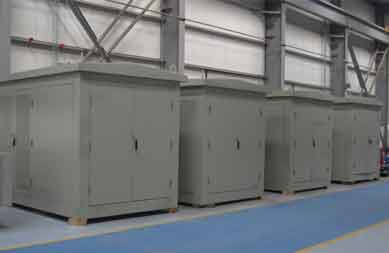
Package & Unit Substations
Fully integrated outdoor compact enclosures combining MV switchgear, CESI type-tested oil or dry-type transformer, and LV distribution boards.
Standard Technical Parameter Matrix
| Technical Parameter | Distribution Transformers | Power & Sub-Transmission Transformers | Special Application / OEM Units |
|---|---|---|---|
| Rating Range | 50 kVA to 3150 kVA | 3.15 MVA to 60 MVA | Custom (Up to 40 MVA) |
| Primary Voltage Class | 11 kV, 22 kV, 33 kV | 33 kV, 66 kV, 112 kV, 132 kV | Up to 33 kV / 66 kV |
| Insulation & Fluid Type | Mineral Oil / Synthetic Ester | High-Grade Mineral Oil / Natural Ester | Ester Fluid / Dry-Type Cast Resin |
| Short-Circuit Certification | CESI / KEMA Certified (IEC 60076-5) | CESI / KEMA Type Tested | Type-Tested Design Baseline |
| Cooling Methods | ONAN / KNAN | ONAN / ONAF / OFAF | ONAN / ONAF / Forced Liquid |
| Vector Groups | Dyn11, Dyn5, Ynd11 | YNd11, YNyn0, ZNyn11 | Multi-phase / Multi-winding (12-pulse, 24-pulse) |
| Standards Compliance | IEC 60076, BS 171, DEWA / SEWA / AADC | IEC 60076, IEEE C57.12, NEMA | IEC, IEEE, NEMA, Special OEM Specs |
4. Future Global Procurement Trends in Transformer Technology
As utilities and industrial enterprises transition toward decarbonization, microgrids, and digitalized grids, procurement criteria for power transformers are evolving rapidly. Technical buyers must consider several long-term industry trends when specifying CESI type-tested equipment:
A. Shift to Biodegradable Ester Fluids (Natural & Synthetic)
Environmental regulations and fire safety codes are accelerating the replacement of traditional mineral oil with natural esters (derived from vegetable oils) and synthetic esters (such as MIDEL 7137). Esters feature a flash point above 300°C (Class K fluid), dramatically reducing transformer fire risk in dense urban areas, offshore platforms, and desert sub-stations. EUROGULF supplies ester-filled transformers engineered to accommodate fluid thermal properties while preserving CESI short-circuit withstand levels.
B. Smart Transformer Integration & Online Diagnostics
Future-proof substations require real-time condition monitoring. Modern CESI type-tested transformers are increasingly specified with integrated fiber-optic hot-spot sensors, online Dissolved Gas Analysis (DGA) monitors, moisture-in-oil sensors, and smart electronic bushings. These IoT-enabled instruments feed predictive analytics platforms, shifting maintenance from scheduled intervals to risk-based asset management.
C. Stringent Eco-Design & Low Total Cost of Ownership (TCO)
Grid operators no longer evaluate transformer bids solely on capital expenditure (CAPEX). Total Cost of Ownership (TCO) models evaluate No-Load Losses ($P_0$, core losses) and Load Losses ($P_k$, copper losses) over a 30-to-40-year lifespan:
$$\text{TCO} = \text{Purchase Price} + (A \times P_0) + (B \times P_k)$$
Where $A$ and $B$ represent the capitalized cost of loss values per kilowatt ($/kW) defined by the utility. By utilizing laser-scribed grain-oriented silicon steel (CRGO) and high-purity electrolytic copper windings, EUROGULF transformers minimize operational carbon footprints and reduce life-cycle losses.
5. Procurement Risk Mitigation: How to Evaluate Type Test Certificates
When purchasing transformers claiming "CESI Type Tested" status, procurement teams must perform strict technical due diligence. Not all certificates offer identical coverage:
- Validity of Design Similarity: Verify whether the manufacturer's offered design matches the core geometry, winding layout, conductor type, and clamping pressure of the unit actually tested at CESI. Substantial design variations invalidate short-circuit similarity claims under IEC 60076-5 Annex B.
- Completeness of Test Report: Ensure the CESI certificate covers full prospective short-circuit peak current and thermal duration tests, rather than isolated dielectric routine tests.
- Factory Routine Quality Assurance: A CESI type-tested design must be paired with consistent quality control during assembly. EUROGULF maintains ISO 9001:2015, ISO 14001:2015, and ISO 45001:2018 certifications, ensuring every factory unit reflects the exact quality of our tested prototypes.
6. Frequently Asked Questions (FAQ) for Transformer Procurement
Partner with a World-Class Transformer Manufacturer
Need certified, high-reliability transformer solutions tailored to your technical specifications? Contact EUROGULF’s engineering team today to review single-line diagrams, technical tenders, or CESI certification reports.
Send an Inquiry